Budapest at the turn of the twentieth century witnessed an architectural revolution that set it apart from every other European capital. While creators in Paris celebrated sinuous cast-iron tendrils at metro entrances, Brussels pioneered total organic residences through the work of Victor Horta, and Vienna pursued refined geometric rationality under Otto Wagner, Hungarian architects embarked on an ambitious quest to forge a distinct national architectural style. This movement, known as magyaros szecesszió, sought to liberate local architecture from academic historicism and foreign Austro-Hungarian influences. At the heart of this artistic rebirth stood Ödön Lechner, a visionary master who famously declared that a true Hungarian formal language did not yet exist but would soon be created. To realize this dream, Lechner combined modern structural engineering with centuries-old cultural motifs, turning the urban landscape of Budapest into a radiant gallery of color, symbolism, and craft.
Lechner’s design language drew inspiration from two primary wells: the living traditions of Hungarian folk art and the ancient heritage of the East. As ethnographer József Huszka documented in his pioneering studies of rural textiles, Hungarian decorative patterns shared historic ties with Middle Eastern and Asian traditions. Lechner embraced this perspective, turning to Persian entrance gates, Sasanian decorative patterns, and the grand durbar courts of Indian Mughal palaces to establish a monumental architectural vocabulary. Simultaneously, he examined local peasant crafts, incorporating stylized tulip shapes, heart motifs, floral embroidery, and patterns found on Szekler shepherd cloaks into his building facades. By scaling up these delicate vernacular ornaments into three-dimensional architectural elements, Lechner transformed humble rural motifs into a proud urban identity.
This creative movement was never confined to Budapest alone. Across the cities of the former Austro-Hungarian realm, Hungarian Secessionism flourished in vibrant regional centers such as Subotica and Oradea, as well as Szeged, Kecskemét, and Târgu Mureș. In each of these towns, local architects adapted Lechner’s principles to reflect municipal pride, creating a shared Central European architectural dialogue that connected quiet provincial avenues to the roaring boulevards of the capital.
Ceramic Innovation and the Zsolnay Legacy
To bring these elaborate decorative visions to life on a grand scale, Lechner required a material capable of enduring the harsh climate and urban soot of a rapidly growing metropolis. He found his ultimate collaborator in Vilmos Zsolnay, the master of the renowned ceramic factory in Pécs, a historic city in southern Hungary. As architectural historian Ákos Moravánszky observed, the emergence of a new monumental architectural vocabulary in Central Europe was made possible by Zsolnay’s ceramic innovations. Together with chemistry professor Vince Wartha, Zsolnay engineered pyrogranite, an exceptionally durable, frost-resistant stoneware ceramic that could be molded into complex sculptural shapes and withstand urban weathering far better than traditional stone or plaster.
Zsolnay also perfected the legendary Eosin glaze, an iridescent coating named after Eos, the Greek goddess of the dawn, which produced a shifting spectrum of metallic colors that changed tone from ruby red to emerald green under the moving sun. By cladding entire facades and rooflines in these radiant tiles, Lechner and Zsolnay created a luminous architectural skin that protected and enlivened the city. The factory produced thousands of custom tiles, relief panels, and decorative roof elements that transformed ordinary structures into glittering landmarks.
The reach of Zsolnay ceramics extended far beyond Budapest and Hungary. Across Europe, architects incorporated these iridescent tiles into their creations. In Vienna, architect Friedrich Ohmann placed massive turquoise Zsolnay vases along the riverbanks in Stadtpark, while Max Fabiani used Zsolnay tiles for the facade of the Portois und Fix building. Further south, Zsolnay elements crowned the fairytale Raichle Palace and the monumental Synagogue in Subotica, adorned the Black Eagle Palace and Ullmann Palace in Oradea, and even graced the Hungarian Pavilion at the Venice Biennale and the stage front of the Teatro de Bellas Artes in Mexico City.
Masterpieces Across the Urban Fabric
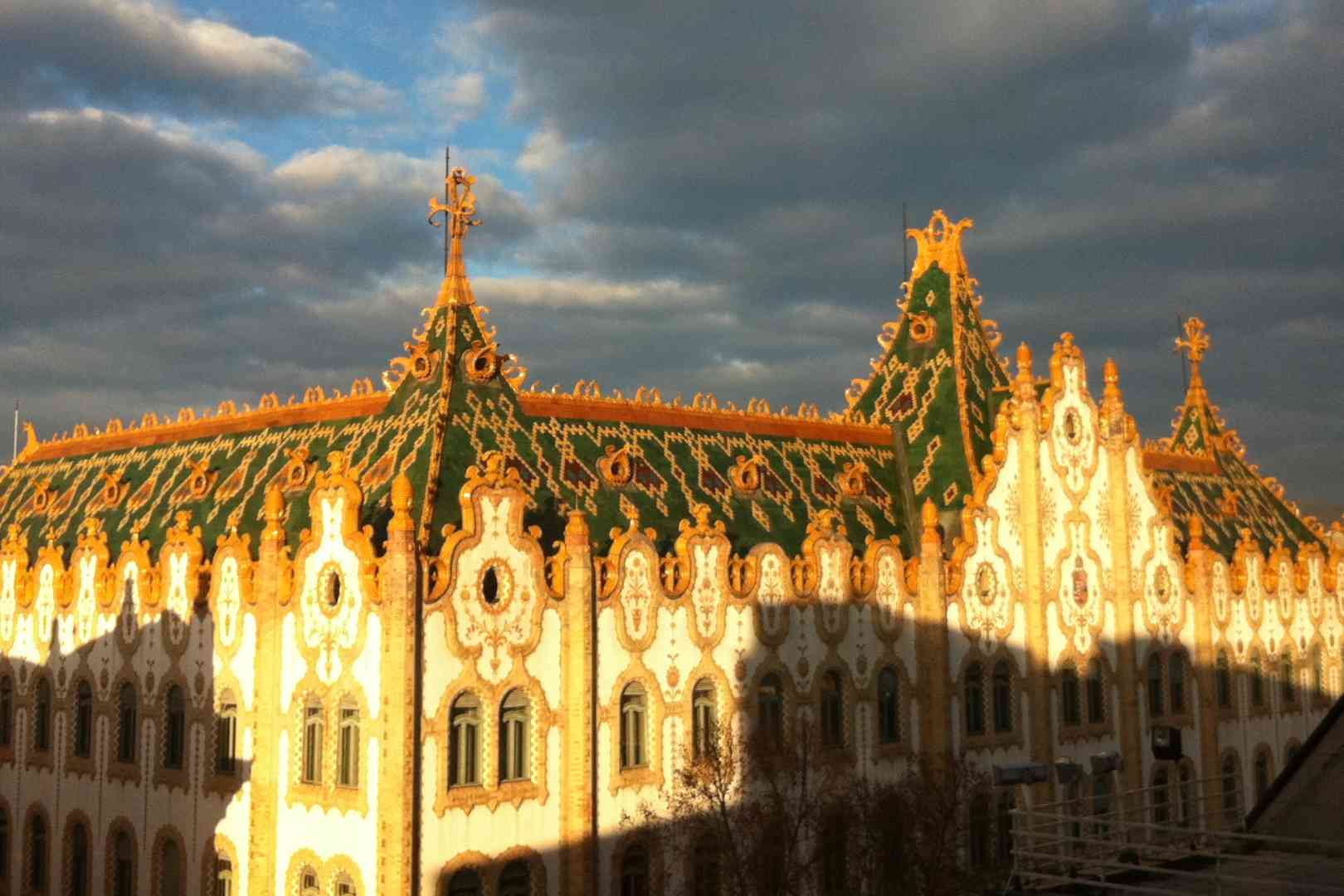
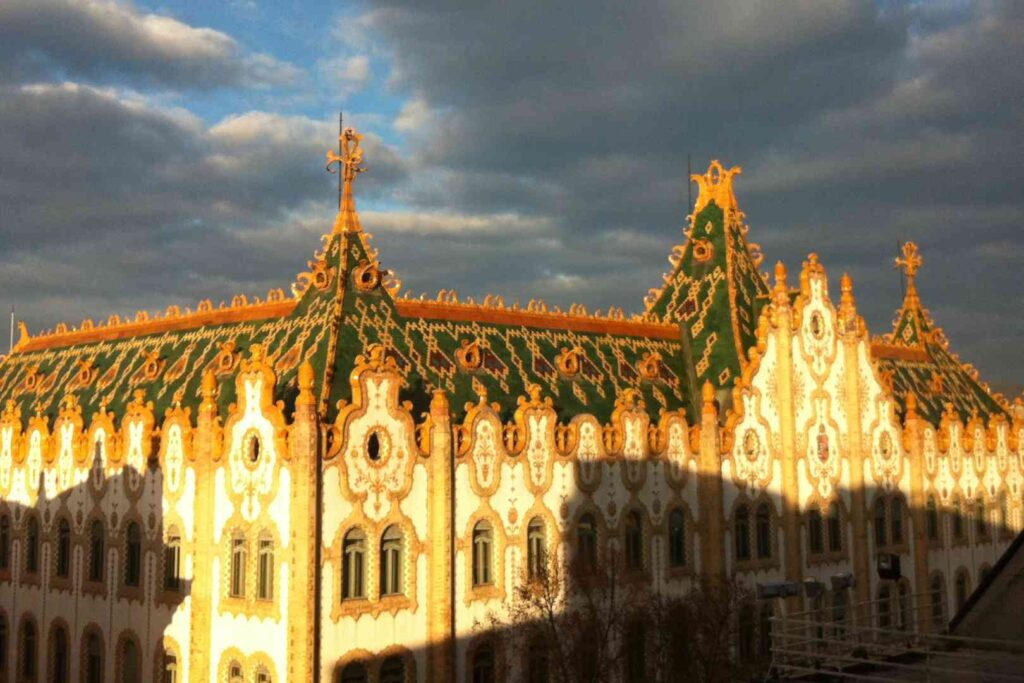
The ultimate embodiment of Lechner’s artistic philosophy is the Museum of Applied Arts in Budapest, completed in 1896 for the Hungarian Millennium celebrations. Designed alongside Gyula Pártos under the competition motto calling for an eastward-looking Hungarian art, the building was influenced by Lechner’s study of London’s South Kensington Museum. It features a fiery roof clad in yellow and green Zsolnay tiles, an octagonal entrance loggia recalling Persian architecture, and a vast glass-roofed interior exhibition hall evoking the majestic court of an Eastern palace. Nearby, Lechner constructed the Royal Hungarian Postal Savings Bank on Hold Street, widely considered his most harmonious creation. The facade of this municipal treasure is embellished with ceramic reliefs derived from folk embroidery, crowned by an extraordinary roofline featuring golden Zsolnay ceramic beehives symbolizing thrift and industry, alongside playful dragon-like gables and decorative pinnacles.
Lechner’s imaginative palette extended across other major districts of the capital, as seen in the Geological Institute on Stefánia Avenue, where an undulating roof clad in deep sea-blue Zsolnay tiles is crowned by ceramic figures holding a globe in tribute to the earth sciences. In the district of Kőbánya, his Saint Ladislaus Church features a striking parabolic tower whose catenary arches revived Gothic spatial thinking through modern structural principles, evoking a structural spirit similar to the organic experiments of Antoni Gaudí in Barcelona.
The enthusiasm for this colorful, folk-inspired style quickly inspired a broader network of master architects who shaped cities across Central Europe. Architects Marcell Komor and Dezső Jakab carried Lechner’s vision to Subotica, where they built the landmark City Hall and Synagogue, and to Oradea, where they designed the magnificent Black Eagle Palace with its glass-roofed pedestrian arcade. In Szeged, architect Ede Magyar created the swirling, waterlily-covered Reök Palace, earning him the title of the Hungarian Gaudí. In Subotica, Ferenc Raichle constructed his personal family palace using colorful ceramic mosaics and Transylvanian wooden motifs, while brothers László and József Vágó brought refined geometric Secessionist elegance from Vienna to the Darvas-La Roche House and Moskovits Palace in Oradea.
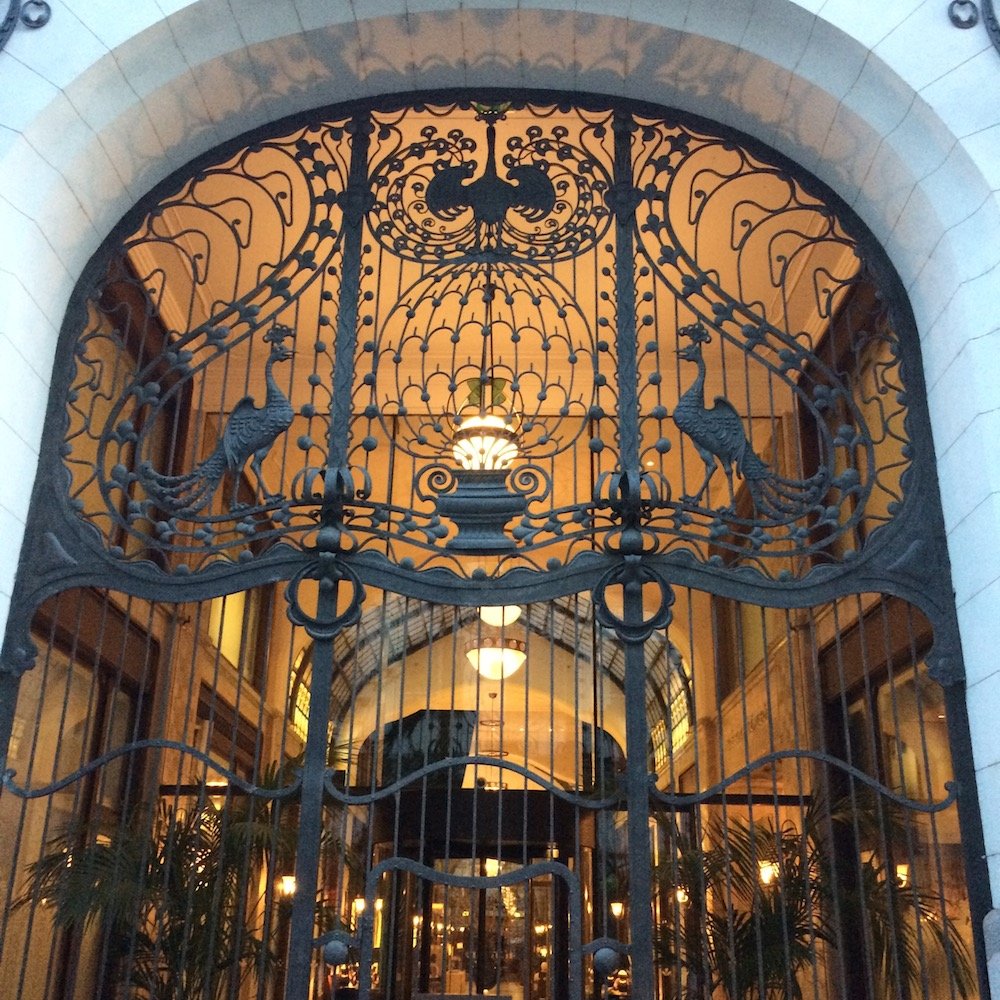
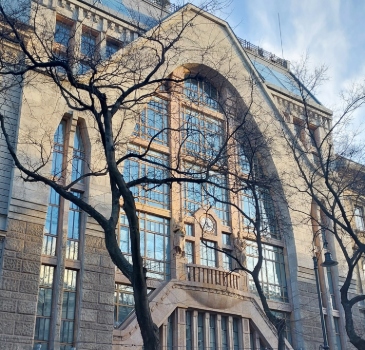
In Budapest itself, this artistic ecosystem produced endless treasures. Henrik Schmahl blended Venetian Gothic arcades with Lechnerian national motifs to create the breathtaking Paris Passage, while Kornél Neuschloss adorned the Elephant House at the Budapest Zoo with turquoise ceramic tiles and whimsical glazed animal heads from the Pécs manufactory. Master craftsman Miksa Róth provided luminous stained-glass windows and gold mosaics for public baths, banks, and private townhouses throughout the city, embodying the spirit of the total work of art that defined European Art Nouveau.
Experiencing Budapest and Europe with Art Nouveau Club
At Art Nouveau Club, we believe that discovering a city’s architectural soul is an experience best enjoyed away from large, rushed tour groups. Our specialized private tours in Budapest are meticulously crafted for cultural travelers, design enthusiasts, and art lovers who want an authentic, in-depth connection with the Szecesszió movement. We partner directly with licensed local guides who are passionate experts in Hungarian art and architectural history, ensuring that every walk or drive reveals the hidden stories, master craftsmen, and cultural contexts behind Budapest’s iconic facades.
Whether you choose a half-day exploration of Central Budapest or an immersive full-day journey across the capital, our private experiences are tailored to your personal pace and interests. Our itineraries take you beyond standard tourist routes to explore private house interiors like the Bedő House, admire exquisite stained glass by Miksa Róth in quiet courtyards, discover hidden ceramic details, and enjoy relaxed moments in historic turn-of-the-century cafés.
Furthermore, https://artnouveau.club connects your journey in Budapest to a wider European story. Beyond the Hungarian capital, we organize private experiences across the continent’s greatest Art Nouveau destinations, including Vienna, Prague, Subotica, Oradea, Brussels, Barcelona, Riga, and Aveiro. By providing exclusive, unhurried tours led by dedicated local experts, Art Nouveau Club ensures your journey through Europe becomes an unforgettable exploration of fin-de-siècle art, architecture, and living heritage.