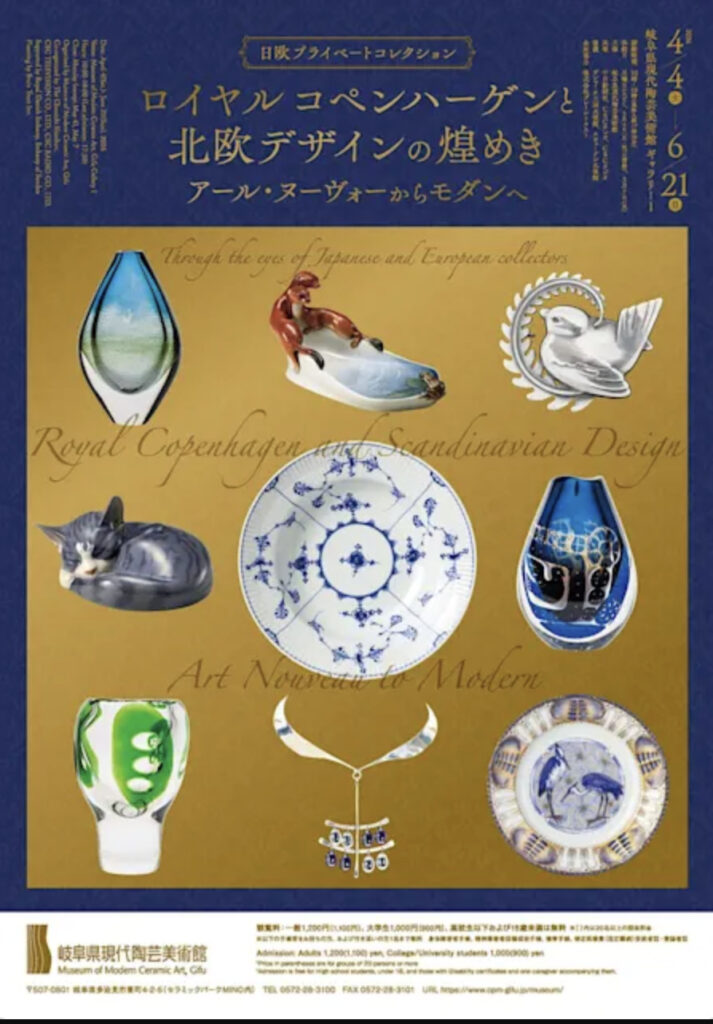
The exhibition Royal Copenhagen and the Brilliance of Scandinavian Design: Art Nouveau to Modern, a landmark presentation of Japan–Europe private collections, opens this spring at the Museum of Modern Ceramic Art in Gifu and runs from April 4 to June 21, 2026. Bringing together around two hundred works from both Japanese and European collectors, it offers an unusually intimate look at the evolution of Scandinavian design, from the organic curves of Art Nouveau to the clarity and restraint of modernism. The show arrives at a moment when interest in Nordic craftsmanship is surging globally, and its setting in one of Japan’s most important ceramic regions adds a compelling cross‑cultural dimension.
In the Nordic countries, where winter darkness stretches for months, beauty has long been cultivated indoors. Everyday objects — tableware, glass, silver, and ceramics — became vessels of light, color, and comfort. This exhibition traces that tradition with particular attention to Denmark and Sweden, two nations whose artisans shaped a visual language that blended natural forms with technical innovation. The curators emphasize that the show is not only about Royal Copenhagen, though the Danish manufactory forms its historical anchor, but also about the intertwined histories of Bing & Grøndahl, Georg Jensen, Rörstrand, Orrefors, and Kosta. Together, these makers defined the Scandinavian aesthetic that would influence design worldwide.
Royal Copenhagen, founded in 1775 as the Royal Danish Porcelain Manufactory, quickly became known for its mastery of underglaze decoration. One of the earliest works in the exhibition, the Blue Fluted Plate from 1795, reveals the delicate cobalt patterning that would become synonymous with the brand. The museum notes that the technique of 釉下彩 (yūkasai), or underglaze painting, advanced rapidly in the late nineteenth century, allowing artists to achieve subtle gradations of color beneath a transparent glaze. This softness — atmospheric, almost watercolor-like — became a hallmark of Nordic Art Nouveau ceramics.
The exhibition also highlights the career of Georg Jensen, who began as a potter at Bing & Grøndahl before founding the silver workshop that bears his name. His Brooch No. 309, created after 1945, distills the organic motifs of Art Nouveau into a sculptural modernist form, demonstrating how Scandinavian design evolved without losing its connection to nature. Sweden’s contributions are equally compelling. Rörstrand, the oldest pottery factory in the Nordic world, is represented by the whimsical Otter and Frog Pen Tray (1897–1910), a piece that captures the playful naturalism of Swedish Art Nouveau. The exhibition then moves into the twentieth century, when the glassmakers of Småland — Orrefors and Kosta — transformed Swedish glass into an international art form. The Ariel Vase designed in 1940, with its suspended bubbles and layered color, stands as one of the great technical achievements of Scandinavian glassmaking, while a 1950s Kosta vase reflects the shift toward modernist simplicity.
These works, drawn from private collections rarely seen by the public, form a dialogue across time and geography. They reveal how Nordic artisans elevated everyday objects into expressions of cultural identity, and how their influence traveled far beyond Scandinavia, inspiring collectors in Japan and around the world. The exhibition’s setting in Gifu — a region with its own centuries‑old ceramic tradition — creates a natural bridge between the two cultures.
The exhibition remains open throughout the spring season, offering visitors nearly two months to explore this remarkable gathering of Scandinavian design. Each morning at ten o’clock, the Museum of Modern Ceramic Art in Gifu opens its doors, allowing the first guests to step into the quiet, light-filled galleries where porcelain surfaces and glass vessels catch the shifting daylight. The museum closes at six in the evening, with final entry permitted until half past five, giving ample time for slow, attentive viewing. Although the museum traditionally closes on Mondays, it will remain open on May 4, a national holiday in Japan, and will instead observe a closure on May 7. Admission is set at 1,200 yen for adults and 1,000 yen for university students, while high school students and younger visitors may enter free of charge. Group discounts are available for parties of twenty or more, and the museum continues its commitment to accessibility by offering free admission to visitors holding designated disability certificates along with one accompanying person.
The museum’s location adds another layer to the experience. Situated at 4‑2‑5 Higashi‑machi in Tajimi City, the Museum of Modern Ceramic Art forms part of Ceramic Park MINO, a cultural complex designed by the late architect Arata Isozaki. The building is set within a landscape of wooded hills, and its architecture incorporates local ceramic materials, echoing the region’s long tradition of Mino ware. Visitors arriving by train can reach the museum by traveling to Tajimi Station on the JR Chuo Main Line or Taita Line, exiting from the south side, and boarding a Toutesu bus bound for the Ceramic Park. After disembarking at the stop named for the museum, a short ten‑minute walk leads through the park’s grounds to the entrance. For those seeking additional information, the museum maintains an English‑language website and can be contacted directly by telephone.
This journey to Tajimi becomes part of the exhibition’s narrative. The region has long been a center of ceramic innovation, and the museum’s architecture — suspended galleries, seismic isolation systems, and the extensive use of local tile — reflects a deep respect for craft. It is a fitting stage for an exhibition that traces the evolution of Scandinavian design from the fluid lines of Art Nouveau to the clarity of modernism. The encounter between Japanese and Nordic craft traditions feels natural here, in a place where the long arc of design history is given space to unfold.
Visitors arriving during the exhibition period will also find a rich program of related events. A commemorative lecture on April 29 explores the history of Royal Copenhagen and Bing & Grøndahl, while a hands-on workshop on June 6 introduces participants to metalworking techniques through the creation of a simple bangle. Gallery talks throughout April, May, and June offer additional insight into the works on display. These programs extend the exhibition beyond the vitrines, inviting visitors to engage with the ideas and techniques that shaped Scandinavian design.
In bringing together these works from Japan and Europe, the exhibition offers more than a historical survey. It reveals a shared sensibility — a belief in the beauty of everyday objects, in craftsmanship as a form of cultural expression, and in the quiet power of design to shape daily life. Whether one is drawn to the delicate underglaze blues of Royal Copenhagen, the sculptural silver of Georg Jensen, or the crystalline depths of Orrefors glass, the exhibition provides a luminous journey through the heart of Nordic design, seen through the eyes of collectors who have cherished these objects across continents.
More info HERE.