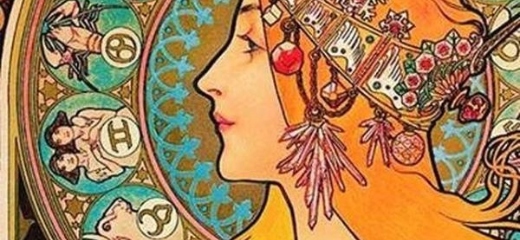
Prague has long been associated with Alfons Mucha’s unmistakable Art Nouveau style. Now, a new permanent exhibition at Central Gallery looks beyond the iconic posters to reveal the artist as a photographer, designer, illustrator and visionary who wanted beauty to become part of everyday life.
For generations, Alfons Mucha has been one of the defining visual figures of Prague. His elongated women, flowing hair, flowers and elaborate ornamental frames have become so familiar that they can sometimes seem inseparable from the city itself.
But behind the instantly recognizable Art Nouveau image was a far more experimental artist.
A new permanent exhibition at Central Gallery, located on Prague’s Old Town Square, presents Mucha from this broader perspective. Rather than simply retelling the familiar story of the artist and his famous Parisian posters, the exhibition explores his photography, graphic design, decorative arts, Czech identity and continuing influence on contemporary creativity.
The new presentation opened in August 2026 and is now part of Central Gallery’s permanent programme. The gallery is housed in the historic White Unicorn House on Old Town Square and presents permanent exhibitions devoted to Mucha, Salvador Dalí and Andy Warhol.
More Than an Art Nouveau Poster Artist
Mucha is often reduced to the glamorous Parisian posters that made him famous. His collaboration with actress Sarah Bernhardt transformed his career in the 1890s, while his work for the Paris printing house of Ferdinand Champenois helped establish the visual vocabulary that would become synonymous with Art Nouveau.
The new exhibition does not ignore those works. Instead, it uses them as a starting point for a much wider portrait.
One of the works highlighted is Le Pater (The Lord’s Prayer) from 1899, an ambitious project in which Mucha combined Christian ideas, symbolism and his own philosophical belief in beauty, truth and love. The exhibition also revisits his commercial commissions and his famous theatre posters, including the distinctive visual language developed through his work with Bernhardt.
One particularly unusual story concerns Kassa, a tall, narrow poster created for American actress Leslie Carter. Mucha adapted the format and visual approach that had become successful with his Bernhardt posters, but the theatrical production failed commercially. Carter eventually went bankrupt, and Mucha reportedly never received payment for the work.
These stories reveal an artist working within the rapidly expanding world of commercial printing, theatre and mass communication — not simply a painter creating isolated works for museums.
The Photographer Behind the Images
Perhaps the most revealing part of the exhibition is its attention to Mucha’s photography.
Long before photography became an everyday tool, Mucha used the camera as part of his artistic process. Photographs allowed him to study models, movement, poses, lighting and composition before translating those observations into drawings and lithographs.
The surviving photographs provide an unusual glimpse into his working method and his Paris studio. They also challenge the idea that Mucha’s decorative style emerged effortlessly from inspiration. Behind those apparently fluid compositions was a carefully controlled process of observation, preparation and experimentation.
The photographs therefore become more than historical documents. They help visitors understand how Mucha constructed the images that would eventually become some of the most recognizable graphics of the Art Nouveau period.
Designing Beauty for Everyday Life
Another important theme is Mucha’s belief that art should not be restricted to galleries or wealthy collectors.
His Documents Décoratifs, published in 1902, brought together ornamental motifs and decorative designs intended as a practical source for artists, architects, designers and craftspeople. The publication demonstrates his ambition to make the visual language of Art Nouveau adaptable to everyday objects and environments.
This idea is central to understanding Mucha’s legacy.
He worked across posters, books, packaging, jewellery, typography, interiors and decorative objects. His art could appear on a theatre wall, in a publication or on an object used in an ordinary home.
In this sense, Mucha was a mass-market artist before the term became fashionable. He understood that graphic art could reach audiences far beyond the traditional museum visitor and that beauty could become part of everyday life.
That makes his work particularly relevant today, when the boundaries between fine art, graphic design, fashion, advertising and popular culture have become increasingly fluid.
From Paris Back to Czech Identity
The exhibition also moves beyond Mucha’s Paris years to examine his relationship with his homeland.
After returning to Bohemia in 1910, Mucha increasingly devoted his work to Czech culture and national identity. His artistic ambitions extended beyond commercial illustration into projects that reflected his interest in history, education and national consciousness.
Among the works presented is a poster for the National Unity Lottery, whose proceeds supported Czech-language and history education. Mucha also designed Czechoslovak postage stamps, demonstrating how his decorative vocabulary could be adapted to national symbols and public communication.
This part of the exhibition adds another dimension to his career: Mucha was not simply an international Art Nouveau celebrity. He was also deeply invested in the cultural identity of his homeland.
A Family Legacy Reimagined
The exhibition’s contemporary perspective becomes particularly clear through the work of Jarmila Mucha Plocková, Mucha’s granddaughter.
An architect and artist, Plocková creates jewellery and engraved-glass objects that echo elements of her grandfather’s visual language without simply reproducing it. Organic forms, delicate lines, craftsmanship and attention to detail connect her work with Mucha’s aesthetic while placing those ideas firmly in a contemporary context.
The result is a dialogue between generations rather than a traditional retrospective.
Mucha’s work is presented alongside contemporary objects, suggesting that the Art Nouveau principles he explored more than a century ago — craftsmanship, ornament, nature and the integration of art into daily life — remain capable of evolving.
Reimagining the Slav Epic
The exhibition also brings Mucha’s monumental Slav Epic into the present through the photography of Jan William Drnek.
Drnek documented Mucha’s twenty monumental paintings in extraordinarily detailed large-format photographs. The project later became the basis for Epopej, an enormous book reproducing the works at approximately life size. The publication involved around 20,000 photographs and more than three years of work, bringing together more than 20 specialists.
The project offers a striking contemporary response to one of the most ambitious chapters of Mucha’s career.
It also reflects one of the exhibition’s central ideas: that Mucha’s work does not belong exclusively to the past. New technologies, photographers and designers continue to find ways of looking at it differently.
Why Mucha Still Matters
The strength of Central Gallery’s new presentation lies in this shift of focus.
Instead of asking visitors simply to admire the familiar Art Nouveau image, it asks them to consider how Mucha actually worked — how he used photography, how he approached commercial design, how he thought about decoration, how he connected art with national identity and why his visual language has continued to inspire designers and artists.
That perspective makes the exhibition particularly timely.
More than a century after Mucha created his celebrated Paris posters, his ideas about accessible design, visual communication and the relationship between art and everyday life feel remarkably contemporary.
And perhaps that is the best reason to look at Mucha again.
Not because his posters are still beautiful — that has never really been in doubt — but because behind those familiar images was an artist who was constantly testing the boundaries between art, design, photography and life.
Visit the Exhibition
Alfons Mucha — permanent exhibition
Central Gallery
Old Town Square 15, Prague 1
The gallery is open daily from 10am to 8pm, with the last admission at 7pm. Central Gallery currently presents permanent exhibitions devoted to Alfons Mucha, Salvador Dalí and Andy Warhol.